Farallon DiskPaper
1,186 words
12K on disk
October 1990
 Farallon DiskPaper
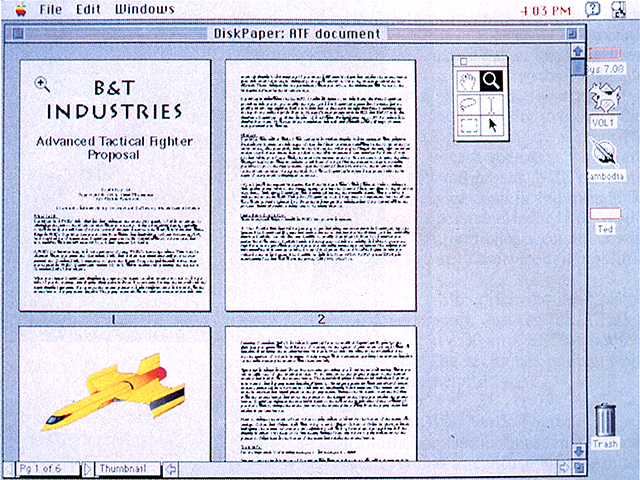
In the Fall of 1990, journalists began writing about a new “print to disk” utility product from Farallon. Seeming to anticipate Adobe’s 1993 Acrobat PDF standard, it was called DiskPaper, but it never shipped from Farallon.
The phrasing of MacWEEK’s September 1990 headline “You Won’t Need Glue” was a reference to a dominant player in the electronic document space, Solutions Inc’s Glue. CEO Tom Evslin has a great narrative of how that early print-to-disk application came to be; strategic mistakes aside, Glue found usage in a few Apple Developer CDs, and no doubt many other enterprise documentation contexts elsewhere.
Farallon, which was essentially a commercial spin-off of the Berkeley Macintosh Users Group (BMUG), successfully marketed products such as PhoneNET LocalTalk cabling and the MacRecorder/SoundEdit microphone system. Now it sought software revenues, perhaps uncoupled from the overhead costs of designing and shipping hardware.
The Sound of Competition
Other developments in late 1990 also influenced the product. Fresh off the introduction of the LC and IIsi with sound-in and bundled microphones, Farallon may have felt the time was ripe to integrate voice annotations into its new portable documents. As the leading vendor of Mac sound input devices until Apple’s entry, the company was no doubt interested in making up with software what it might soon lose in hardware sales. Noting that “Farallon’s new $149 DiskPaper document-distribution program will support sound annotation,” MacWEEK quoted the director of marketing with a classic “this legitimizes the market” take :
After six years of having digital sound technology, Apple has finally said sound is worth something… So we’re thrilled to see Apple get up and say sound is important as a business productivity tool.
Bitmaps vs Outlines
Farallon’s solution to the portable document problem differed significantly from the product that would eventually best it, Adobe Acrobat. The long shadow of PDF makes it hard to think of a time when it wasn’t the obvious solution to any cross-platform complex document representation. But launching into a market defined by small players, such as Glue — and no doubt aware of what Adobe was rumored to be working on — Farallon chose an explicitly non-Postscript path. MacWEEK’s October preview of the software laid out the decidedly raster strategy:
DiskPaper preserves not only QuickDraw and 72-dpi bit-mapped images of the original document, but also, optionally, PostScript and 300-dpi representations. The result, according to Farallon, is screen display and printed copy that exactly match the original document, whatever the resolution of the output device and even if the recipient does not have fonts used in the file.
The Shadow of Farallon Annotator
Perhaps ominously, Farallon had tried to ship a product in this space before. Their Annotator document markup tool had been under development since at least 1988. Annotator promised to let users “add recorded speech notes if you have Farallon’s MacRecorder” , “something you can’t do with a red pen and a Post-it.”
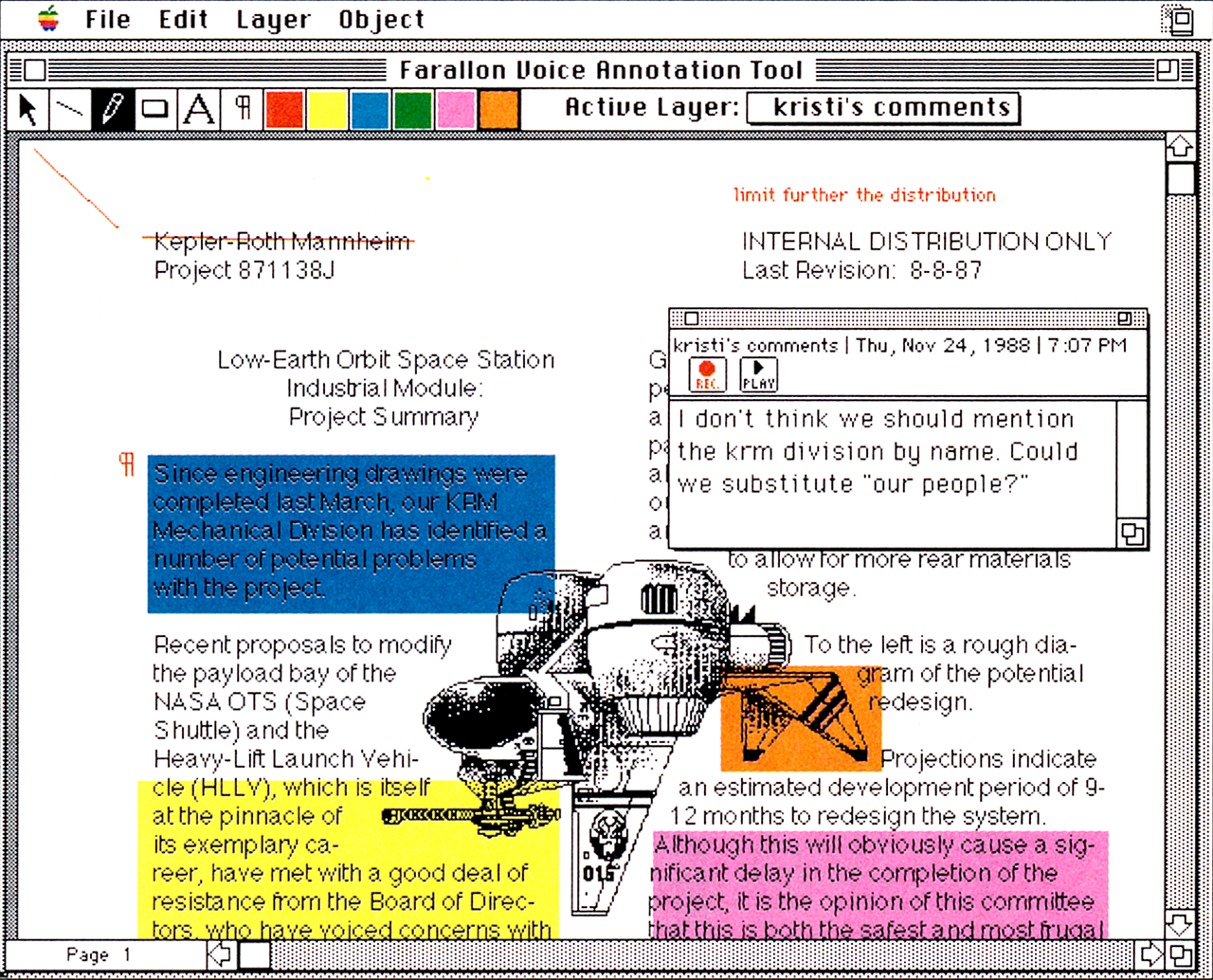
Annotator was mentioned as late as November 1989, with Macworld’s Dave Kosiur — author of the May preview in the same magazine — assuring readers that “Annotator is actually more than a group editing program, but I won’t go into the distinctions here.” A pity, as it wasn’t until the apparently imminent launch of DiskPaper ten months later that MacWEEK revealed:
DiskPaper will not offer text annotation capabilities… Instead, DiskPaper will complement Annotator, another program under development at Farallon that lets users annotate documents with sound and text comments. Originally shown by Farallon in 1988, Annotator was later “unannounced” but is still in the pipeline, sources said.
Annotator, like DiskPaper, never shipped from Farallon.
Acrobat forces Farallon’s hand
DiskPaper hovered in the background throughout 1991 and 1992, existing as a (future?) item on mail-order catalog pages, and even garnered a mention in the March issue of MacUser on Eddy Award contenders. From this we learned it would be able to create self-launching applications and that DiskPaper documents would keep their color and fonts intact. A good deal of exposure in highly technical circles resulted from Apple distributing the electronic documentation for System 7, then in Beta, in DiskPaper format on CD-ROMs.
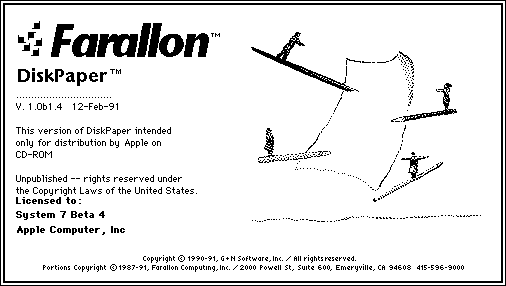
DiskPaper Reader version 1.0b4 shipped on Apple’s first Beta CD of the new operating system in early 1991, and distributed along with that application was a Read Me that gives a sense of the development progress for DiskPaper.
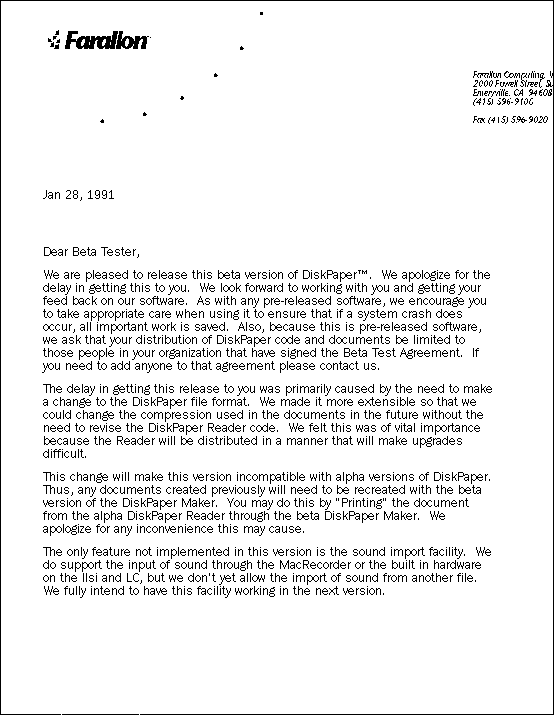
(The irony of DiskPaper cutting off its own company’s letterhead on the right side is not lost on us.)
All of this is consistent with entries being prepared in catalog systems, and beta copies floating around — but not software shipping to stores. MacWEEK’s rumor columnist Mac the Knife dangled a launch date of April 1992:
DiskPaper-less office
Reports have begun to reach the Knife that Farallon is at last getting ready to release DiskPaper, its oft-delayed print-to-disk product, sometime late in April. What got the Knife’s attention was the discovery of a Windows version of DiskPaper under development. When you consider these two products together with the Windows version of Timbuktu, itself one of the worst-kept secrets in the industry, the possibilities for cross-platform mischief are enticing.
But April came and went, with no DiskPaper in sight. By 1993, the portable document market was heating up again with anticipation of Acrobat. Adobe was promising to do for the screen what PostScript had done for the printed page: provide a universal format for the digital exchange of files authored in different programs and disparate platforms. Competitors knew that they had to get their similar products out immediately, or be swamped by this well-known and trusted brand. Perhaps for this reason, DiskPaper found a new home.
The May 24th issue of MacWEEK featured a full-page advertisement promoting “Our unique DigitalPaper technology”. But the company wasn’t Farallon.
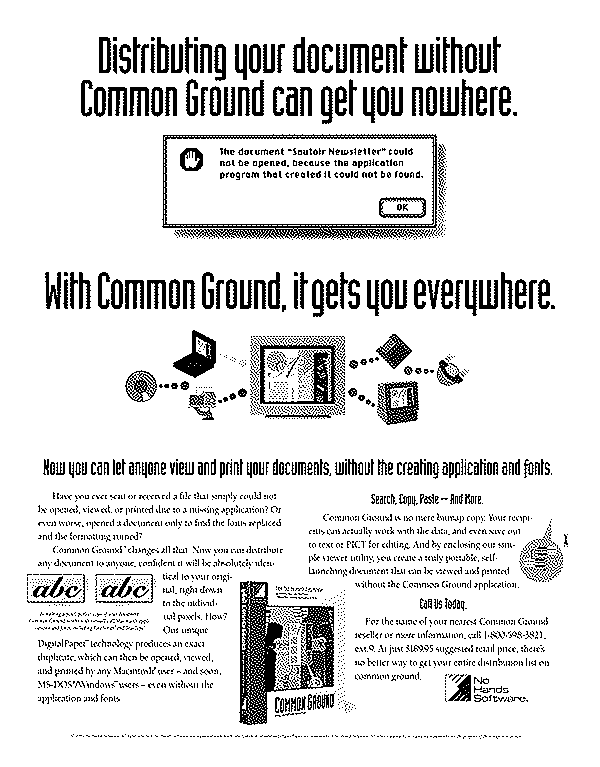
“Using technology that Farallon Computing Inc. originally announced in its never-released DiskPaper product,” MacWEEK explained, No Hands Software had come up with Common Ground for the Macintosh. The company had shown the software at Macworld Expo in January , with shipments promised for February but in fact delayed till May. Nevertheless, MacWEEK called the race: Common Ground was “out ahead of Acrobat”. A Windows version would come by the Summer, and in a very 1993 moment, the Apple Newton was also assured future support.
In place of the Chooser-level PDFWriter, Common Ground offered the “Common Ground Maker” in the Chooser for exporting to the new format. Users could choose to password-protect the resulting file, or (surely due of the Farallon heritage) attach a voice annotation to it via MacRecorder.
A full review of Common Ground will have to wait for another article, but we can at least we can say that some of the ideas and code that had been floating around the valley for three years had finally been shipped.


Information about Farallon DiskPaper